
AI Study Tool With Spaced Repetition and Active Recall: How It Works
The two most proven study methods in cognitive science are active recall — testing yourself from memory — and spaced repetition, reviewing that material on a rising schedule. An AI study app automates both from your own notes: it turns your material into recall questions and schedules each one for the moment you are about to forget it.
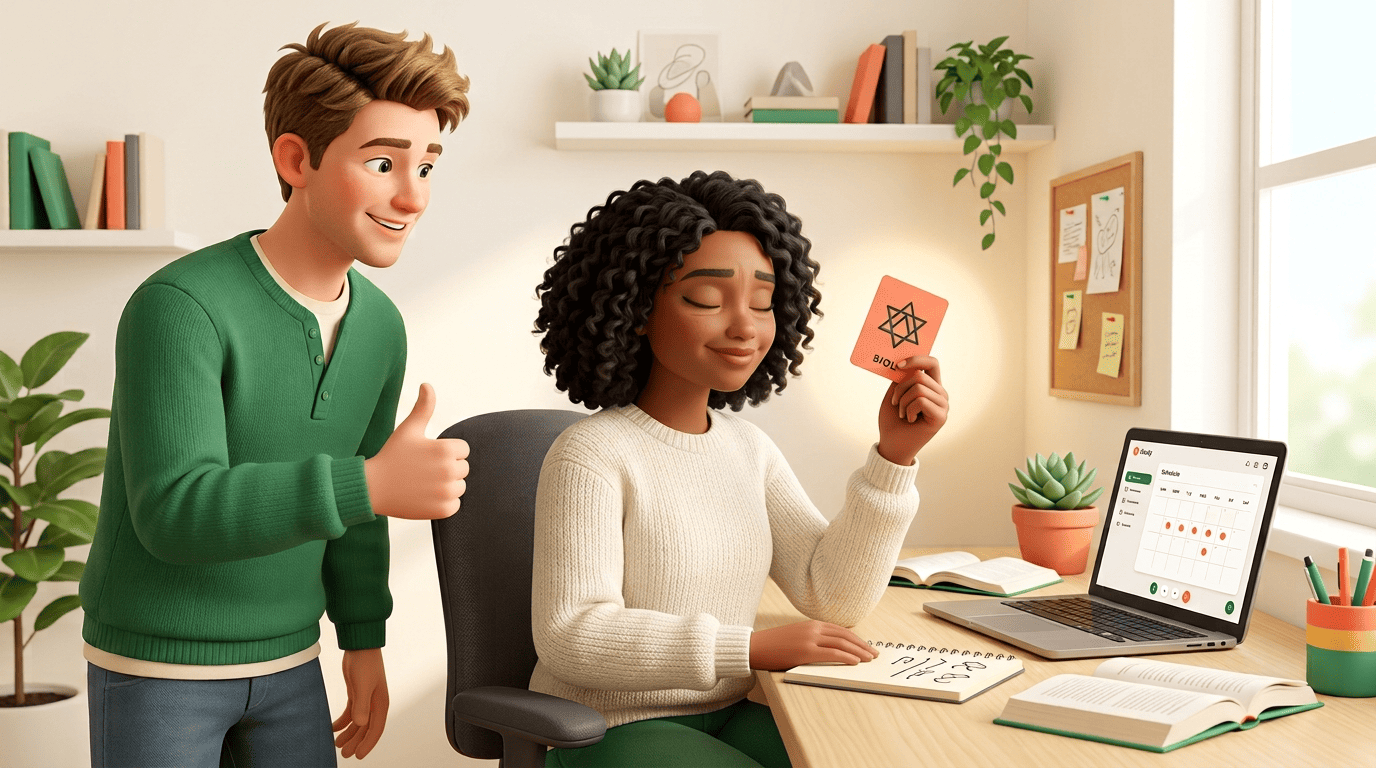
The distinction is worth pinning down in one line. Active recall is what you do (retrieve an answer); spaced repetition is when you do it (the review schedule). The AI handles the timing so you can spend your effort on the retrieval itself.
Active recall vs spaced repetition: the difference
People often blur these two ideas, but they play different roles. Active recall is the act of pulling an answer out of your head. It takes many forms:
- Flipping a flashcard and answering before you check
- Closing the book and reciting a definition
- Taking a closed-book practice quiz
Spaced repetition, by contrast, is the timetable that decides when each of those items comes back for another round of recall.
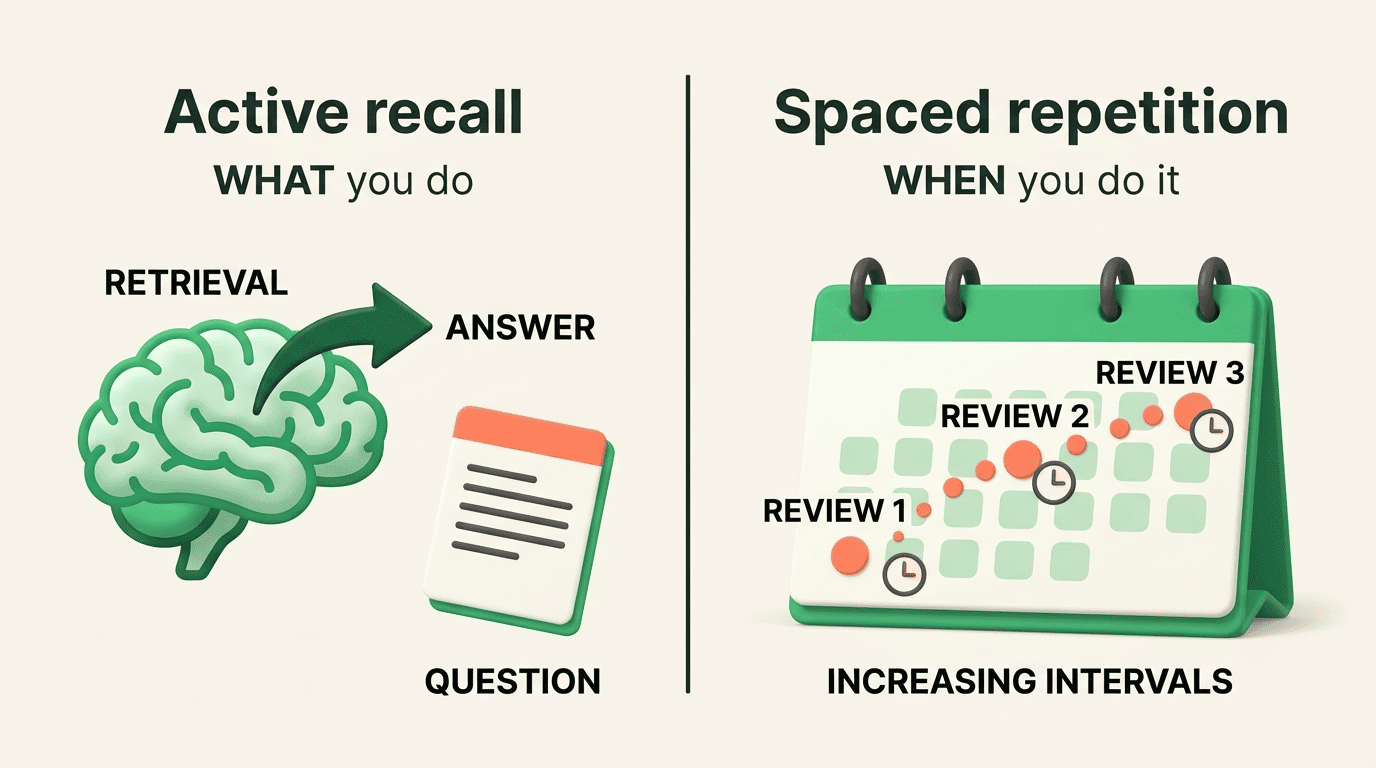
They are complementary, not competing. Retrieval is the mechanism that builds memory; spacing is the schedule that decides how often you trigger it. A good AI study tool combines them: every review is an act of recall, and every recall is timed by the schedule.
| Active recall | Spaced repetition | |
|---|---|---|
| What it is | Retrieving from memory | The review schedule |
| The question it answers | What do I do? | When do I do it? |
| Without it | You just re-read | You cram everything at once |
| In an AI tool | Auto-generated questions | Auto-timed reviews |
Why they work: the forgetting curve and the testing effect
Both methods exist to fight the same enemy: normal human forgetting. Two well-established findings explain why they work.
The forgetting curve
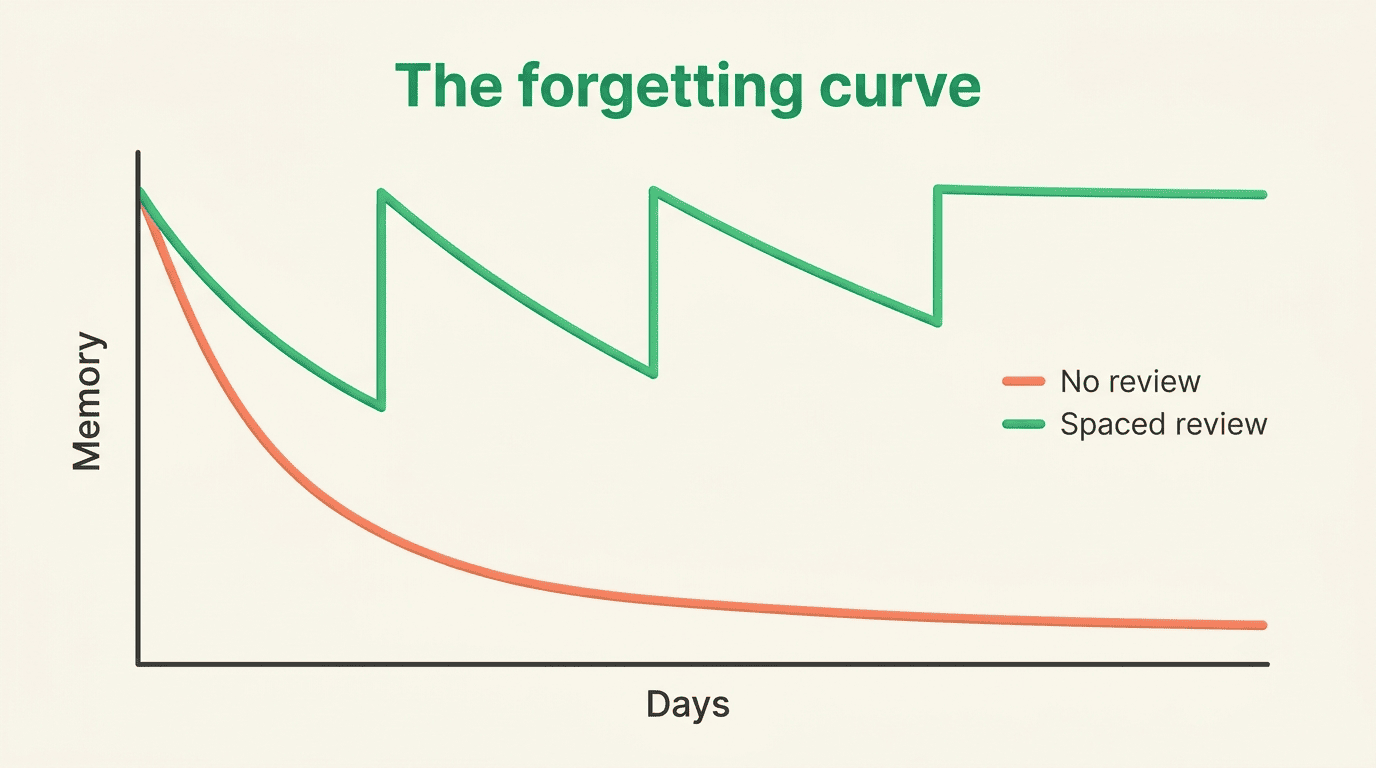
Over a century ago, Hermann Ebbinghaus showed that memory decays on a predictable path: most forgetting happens in the first hours and days after learning, then the loss slows down. This pattern, the forgetting curve, has been replicated consistently across more than a hundred years of research.
Spaced repetition works by interrupting that decay. Each time you successfully recall an item, you reset and flatten the curve, so the next review can safely come later. The intervals grow — a day, then a few days, then weeks — because each retrieval makes the memory more durable.
The testing effect
The second finding is the testing effect: retrieving information strengthens memory far more than reviewing it. Simply re-reading a page feels productive but does little; forcing yourself to answer strengthens the trace, a result documented in peer-reviewed work indexed by the National Institutes of Health.
This is why flashcards beat highlighting. The value is not in seeing the answer again — it is in the struggle to produce it before you check. That struggle is exactly what active recall forces and what a quiz-style AI study assistant is built to create.
How an AI study tool applies them
Doing active recall and spaced repetition by hand works, but it is tedious: you have to write the questions and track the schedule yourself. This is where the AI earns its place.
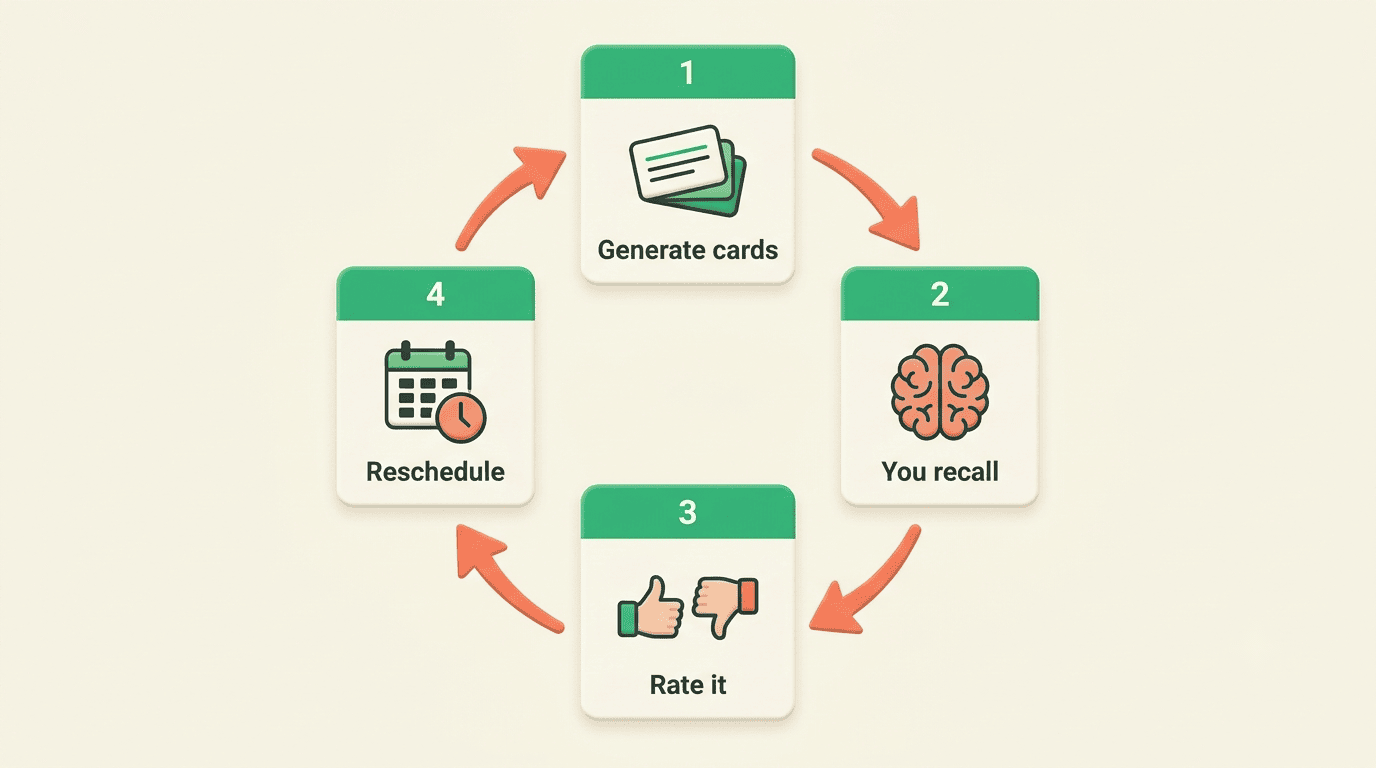
It generates the recall questions. Upload notes, a PDF, or even a lecture recording, and the tool writes question-and-answer cards from your own material — no manual typing.
It schedules every review. Instead of you guessing when to revisit a card, the tool assigns each one a due date and surfaces it when it is time.
It adapts to you. The tool watches your accuracy and how quickly you answer, then shortens intervals for cards you miss and stretches them for cards you know cold — in effect building a personalized forgetting curve for each item.
It recalibrates continuously. Every answer updates the schedule, so the system keeps tuning itself to your real performance rather than a fixed timetable.
The algorithm behind the schedule
That scheduling is not magic — it is a specific algorithm. The classic one is SM-2, developed by Piotr Woźniak for SuperMemo in the 1980s and still the basis of popular apps like Anki.
SM-2 attaches an “ease factor” to every card. When you rate how well you recalled it, the algorithm multiplies the current interval by that ease:
- Cards you find easy stretch further into the future
- Cards you find hard come back sooner
- A card you fail resets to the start
Newer systems such as FSRS refine this with more accurate memory modeling, but the principle is the same — expand the gap as long as you keep succeeding.
A typical schedule for a card you keep getting right looks like this:
| Review | Interval until next review |
|---|---|
| 1st correct | 1 day |
| 2nd correct | ~3 days |
| 3rd correct | ~7 days |
| 4th correct | ~2 weeks |
| 5th correct | ~1 month+ |
The evidence
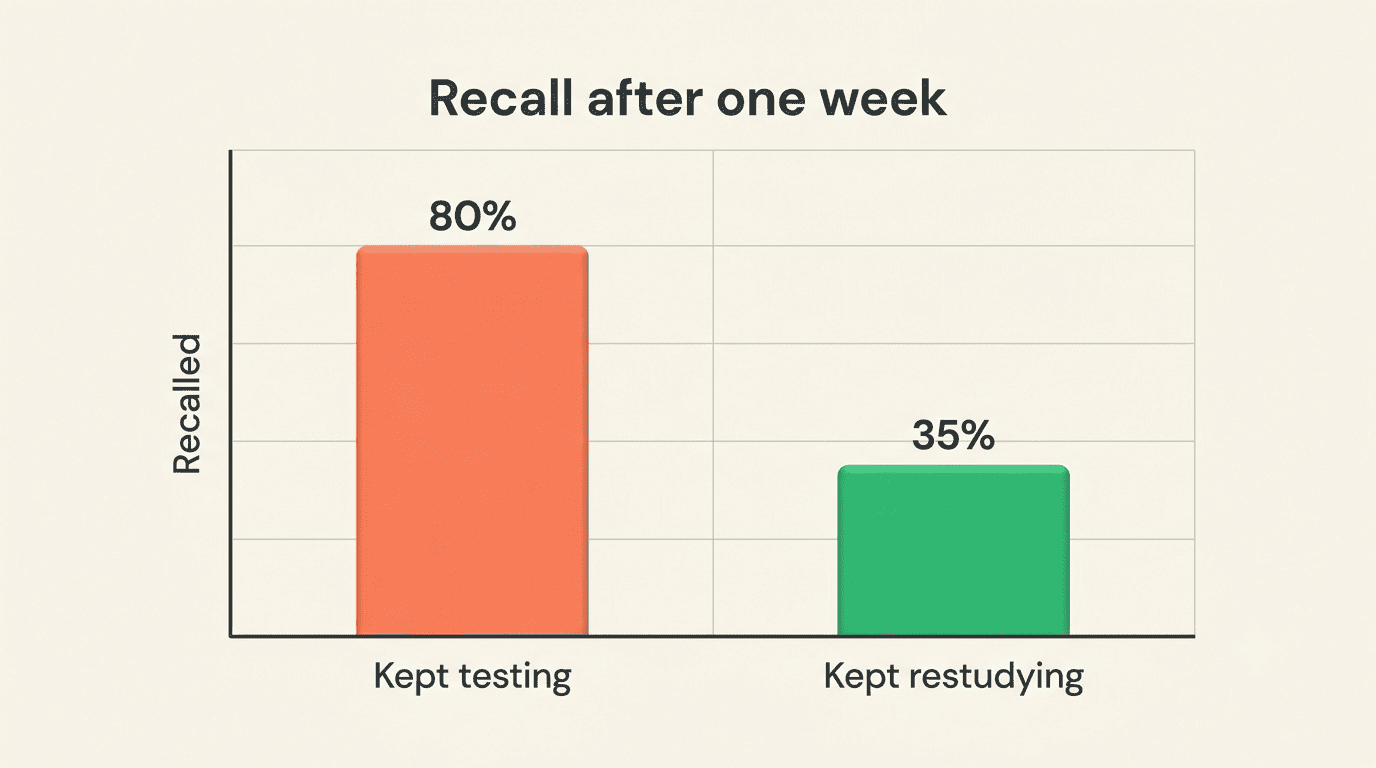
These methods are backed by some of the strongest results in learning science. In an influential 2008 study in Science, Jeffrey Karpicke and Henry Roediger had students learn foreign-language word pairs, then either keep testing themselves or keep restudying. A week later, the students who kept testing recalled about 80% of the items, while those who kept restudying recalled only about 35%.
Retrieval of previously studied information can increase its long-term retention more than repeated study or elaborative encoding of the information.
Karpicke & Roediger (2008), Science
Spacing has equally deep support. A large meta-analysis by Cepeda and colleagues reviewed 317 experiments and found that spaced practice reliably beats massed practice — the technical name for cramming. Put simply, the same hours spread across days will out-teach the same hours packed into one night.
Accuracy and academic integrity
Two honest caveats before you rely on any AI study app. First, auto-generated cards can be wrong or ambiguous, so skim each deck and verify anything important against your notes before you trust it.
Second, keep the purpose straight: an AI study tool with spaced repetition and active recall is for training your own memory, not for doing graded work or cheating. A few simple guardrails:
- Use it to quiz yourself, never to answer a graded assessment.
- Upload only your own notes and materials.
- Follow your institution’s policy on AI, and disclose use where required.
The whole point is that the recall has to happen in your head — outsourcing that defeats the method entirely.
How to study with active recall and spaced repetition
You can put both methods to work in a simple loop:
- Turn your notes into questions — or let the AI study app generate them from your material.
- Answer each card from memory before you look at the answer.
- Rate your recall honestly; do not mark a card easy just to move on.
- Trust the schedule and review the cards the tool surfaces each day.
- Keep sessions short and daily rather than long and rare.
- Verify any card that looks wrong against your source.
Stick with the loop and the intervals do the heavy lifting. If you want a wider view of how these methods fit alongside summaries, quizzes, and explanations, it helps to see what a full toolkit for using AI for studying can do across a whole course.