
AI Study Quiz and Practice Test Generator: How It Works and How to Use It
An AI study quiz and practice test generator turns your own notes, PDFs, or slides into ready-to-take questions in seconds. Instead of copying material into flashcards by hand, you upload a file to an AI study quiz maker, pick how many questions and which formats you want, and it hands back a practice test you can start taking right away.

The payoff is bigger than convenience. Self-testing — answering questions from memory before the real exam — is one of the most evidence-backed study methods in cognitive science, and a generator removes the one thing that usually stops students from doing it: the effort of writing the questions.
What an AI quiz generator does
An AI quiz generator is a tool that builds practice questions and full practice tests from material you give it. You are not limited to typed notes — most tools accept a range of inputs:
- Typed or handwritten notes
- PDFs and textbook chapters
- Lecture slides and presentations
- Web pages and articles
- Recorded lecture audio (transcribed first)
The output is a draft quiz you own and can edit. That is the important difference from a generic quiz you find online: a good AI practice test generator writes questions about your class, from your material, so every question is relevant to what you will actually be tested on.
It also differs from writing questions yourself. Building a solid practice test by hand is slow and, ironically, requires you to already know the material well enough to test it. The generator does the drafting; you do the studying.
How an AI quiz generator works
Behind the one-click experience is a short, predictable pipeline. Knowing it helps you see where quality can slip.
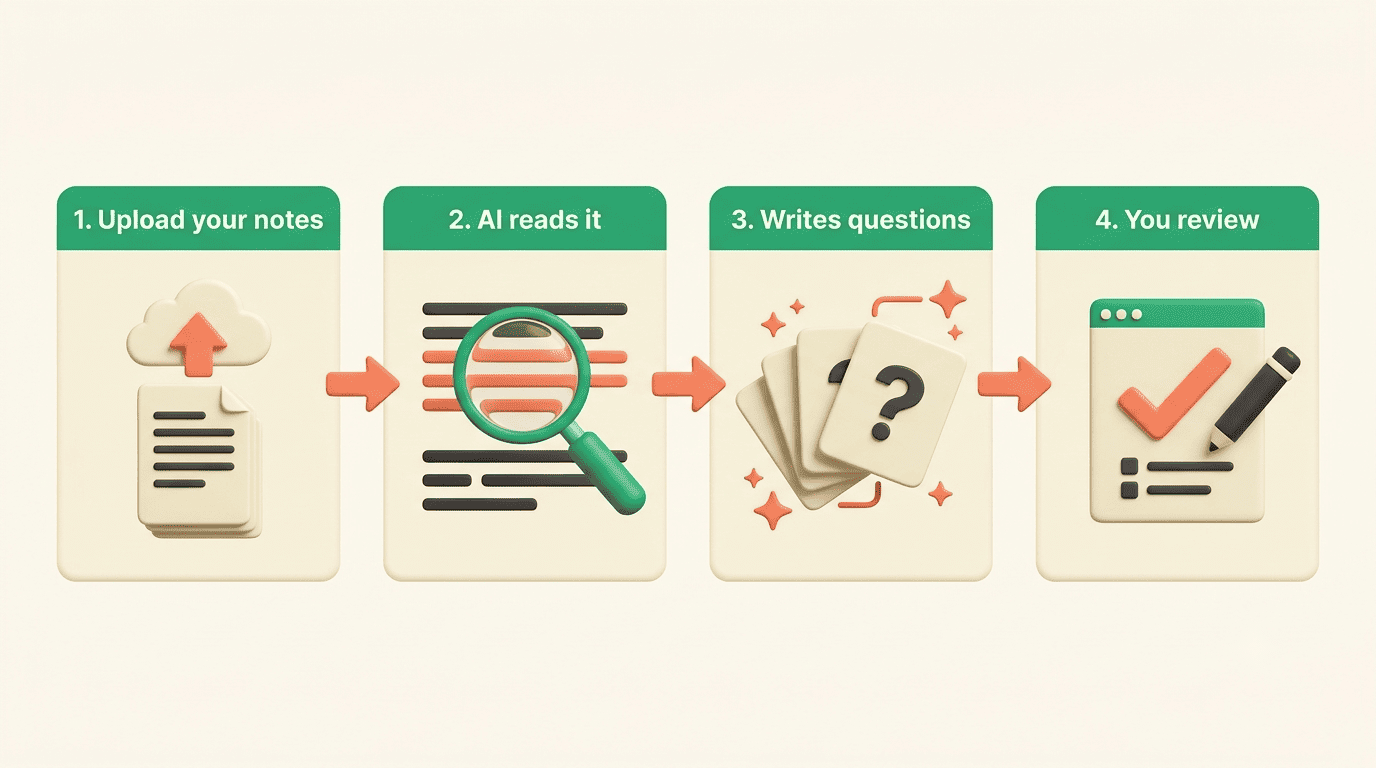
Step 1 — You upload your material
The tool ingests your file. Scanned PDFs, photos of handwritten notes, and images are first converted to text using optical character recognition (OCR), so even a phone snapshot of a page can become a quiz.
Step 2 — The AI reads and finds testable ideas
A large language model reads the text and identifies the key concepts, definitions, and relationships — the parts worth turning into a question. This is the same language technology behind other study aids, applied to question-writing.
Step 3 — It writes the questions
The model drafts questions in the formats and quantity you selected, along with answer keys and, often, short explanations for each answer.
Step 4 — You review and regenerate
You skim the draft, fix or delete weak items, and regenerate for more practice. This review step matters because question quality depends on how closely the output stays tied to your source. As one guide to AI question tools puts it, if the quiz is not tied closely to the source, it “may look fine at first glance and still be a waste of time.”
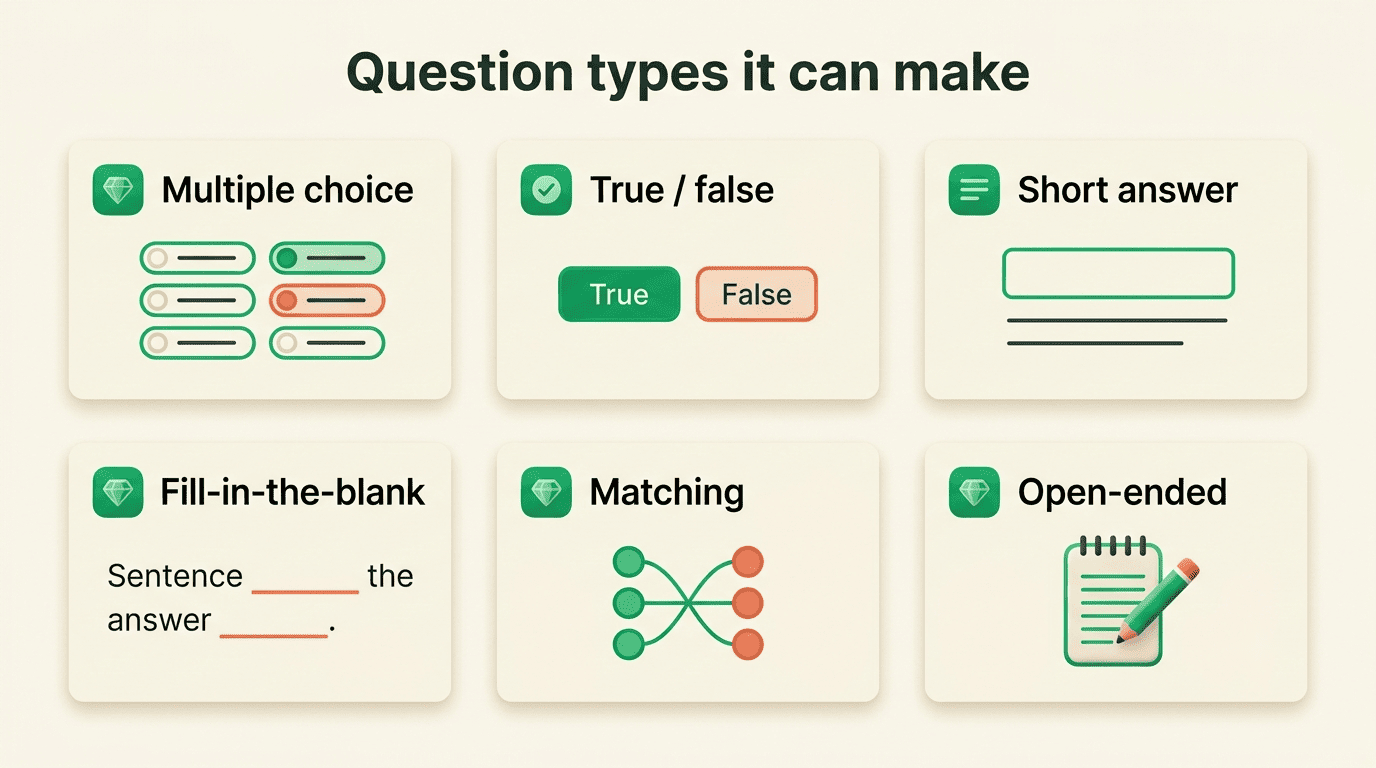
Question types an AI quiz generator can make
A capable AI quiz maker does far more than multiple choice. The common formats, and when each is useful:
| Question type | Best for |
|---|---|
| Multiple choice | Fast coverage, recognizing correct answers |
| True/false | Quick checks on definitions and claims |
| Short answer | Recalling terms and facts from memory |
| Fill-in-the-blank | Key vocabulary and formulas |
| Matching | Linking terms to definitions or dates |
| Open-ended | Explaining and applying concepts |
Mixing formats keeps a practice session honest. Multiple choice is easy to guess; short-answer and open-ended questions force real recall, which is where the learning happens.
Difficulty: quizzing at the right cognitive level
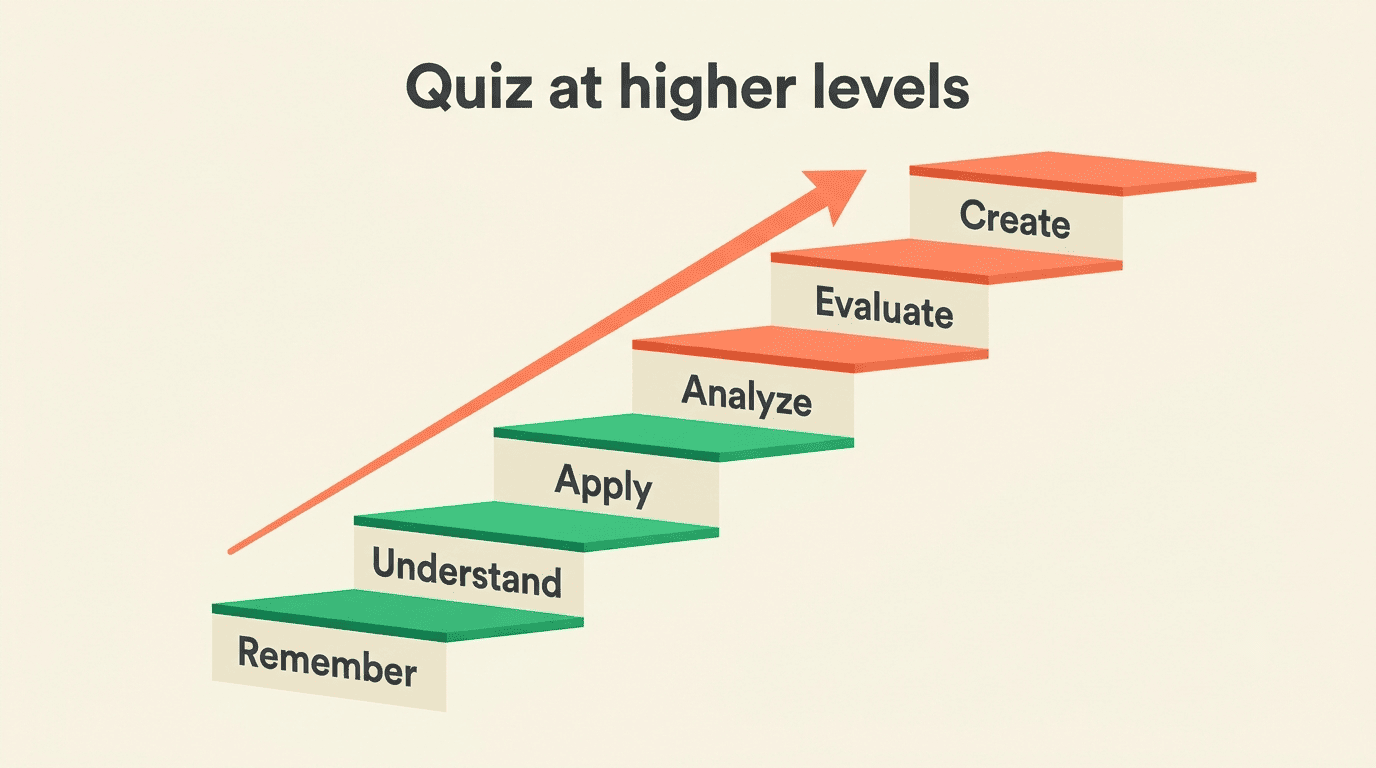
The best generators let you aim higher than rote memory. Questions can be written to target different levels of thinking, from simple recall up to analysis and application.
A useful map here is Bloom’s revised taxonomy, which ranks thinking across six levels:
- Remember — recall facts and terms
- Understand — explain ideas in your own words
- Apply — use a concept in a new situation
- Analyze — break a problem into parts
- Evaluate — judge or justify a position
- Create — combine ideas into something new
The University at Buffalo describes how each level demands deeper cognitive work than the last. A quiz that only asks you to remember definitions is weaker preparation than one that makes you apply a concept to a new problem, so it is worth asking your quiz maker for higher-order questions, not just recall.
Why practice tests actually work
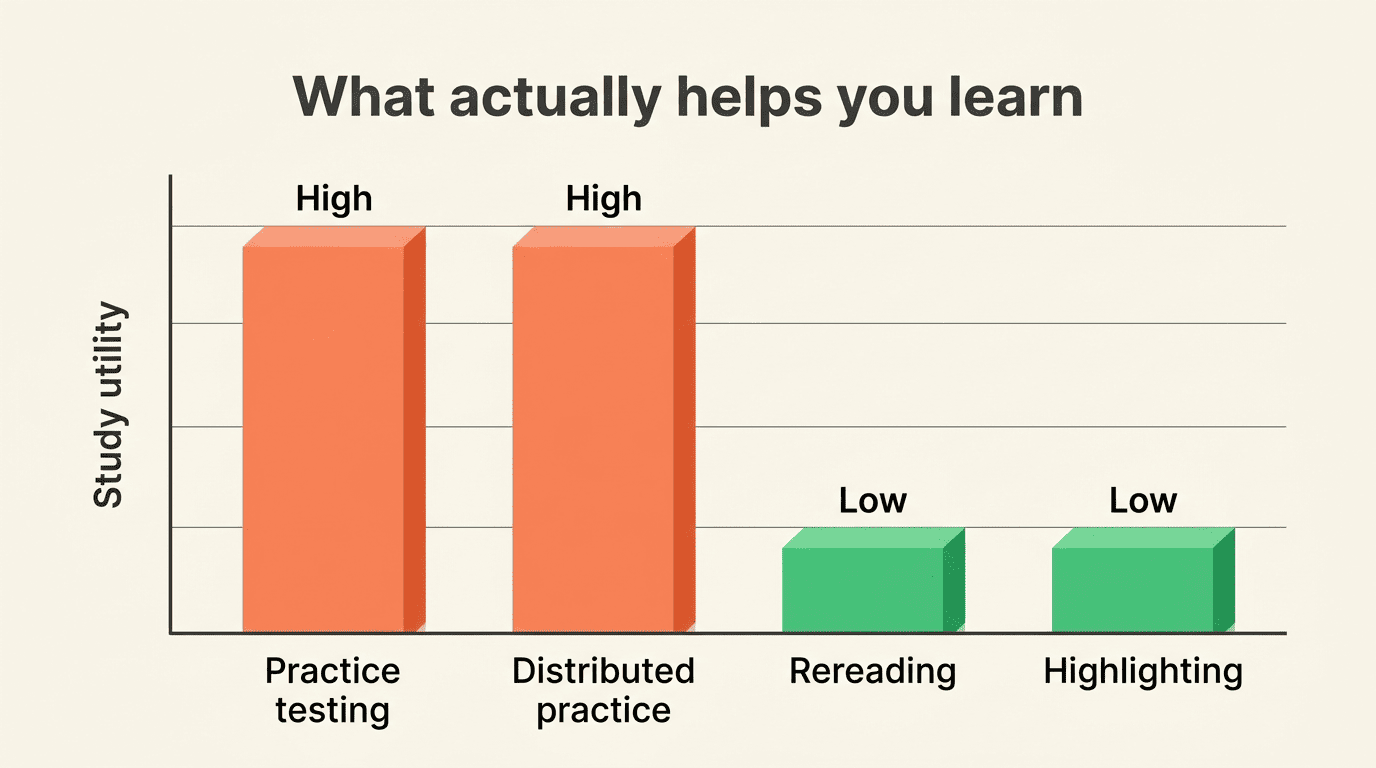
Practice testing is not a study hack of the moment — it is one of the most thoroughly researched techniques in education. In a landmark 2013 review, John Dunlosky and colleagues rated ten common study techniques by how much they actually help. Only two earned the top “high utility” rating: practice testing and distributed practice. Highlighting and re-reading — what most students actually do — landed near the bottom.
| Study technique | Utility rating (Dunlosky 2013) |
|---|---|
| Practice testing | High |
| Distributed practice | High |
| Elaborative interrogation | Moderate |
| Self-explanation | Moderate |
| Interleaved practice | Moderate |
| Rereading | Low |
| Highlighting / underlining | Low |
| Summarization | Low |
Practice testing and distributed practice received high utility assessments because they benefit learners of different ages and abilities and have been shown to boost students’ performance across many criterion tasks.
Dunlosky et al. (2013), Psychological Science in the Public Interest
The mechanism is the testing effect: the act of retrieving an answer strengthens the memory more than re-reading ever could, a result documented in peer-reviewed work indexed by the National Institutes of Health. There is even a counterintuitive twist — getting a practice question wrong and then seeing the right answer still improves your later recall. An AI quiz generator matters because it makes this proven method effortless to run again and again.
Accuracy: check the questions before you trust them
AI-generated questions are usually good, but not always. The underlying language model can hallucinate — write a plausible question with a wrong answer key, or drift away from your actual notes.
Treat the generated quiz as a draft, not gospel. Verify each answer against your source material, delete anything that looks off, and regenerate. A few minutes of checking keeps you from memorizing a confident mistake.
Is it cheating to use an AI quiz generator?
Making yourself a practice quiz is legitimate studying — it is one of the best things you can do. Using an AI tool to answer a graded quiz or exam is not, and the distinction is worth stating plainly: an AI study quiz maker is for practicing and testing yourself, not for doing graded work or cheating.
A few sensible guardrails, echoed by college study guides:
- Upload only your own notes.
- Get your professor’s permission before uploading shared course materials like slides or handouts.
- Check your institution’s academic integrity policy on AI, and disclose use where required.
The goal is to test your own memory, not to outsource it.
How to get the most out of an AI quiz generator
A generator is only as good as how you use it. To turn it into real learning rather than busywork, follow a simple routine:
- Upload real course material, not generic web text.
- Ask for a mix of question types, weighted toward short-answer and open-ended.
- Push the difficulty up to Apply and Analyze levels, not just recall.
- Take the quiz closed-book — the struggle is the point.
- Verify any answer you are unsure about against your notes.
- Space your attempts across days instead of cramming.
Used this way, a quiz generator becomes a study-with-AI habit that compounds — a proven method made effortless enough to actually repeat.