
AI Study Help for Exam Prep: A Smarter Way to Get Ready
AI study help for exam prep can turn your notes, slides, and past papers into a study plan, practice tests, and clear explanations in minutes. Used well, AI study for exams saves hours of busywork, but your grade still comes down to one thing: how you use those materials, not how fast an app made them.
This guide covers what an AI study assistant can actually do before an exam, and how to pair it with the two habits university learning centers keep recommending, practice testing and spaced practice.
What an AI Study Assistant Can Actually Do for Exam Prep
An AI study assistant reads your course material and turns it into study-ready assets. You upload notes, lecture slides, or a past exam, and it produces the things you would otherwise build by hand. Northeastern’s student guide on using AI to prepare for quizzes and exams frames the key rule: let it generate, but answer the questions yourself before reading any AI explanation.
From your material to study assets
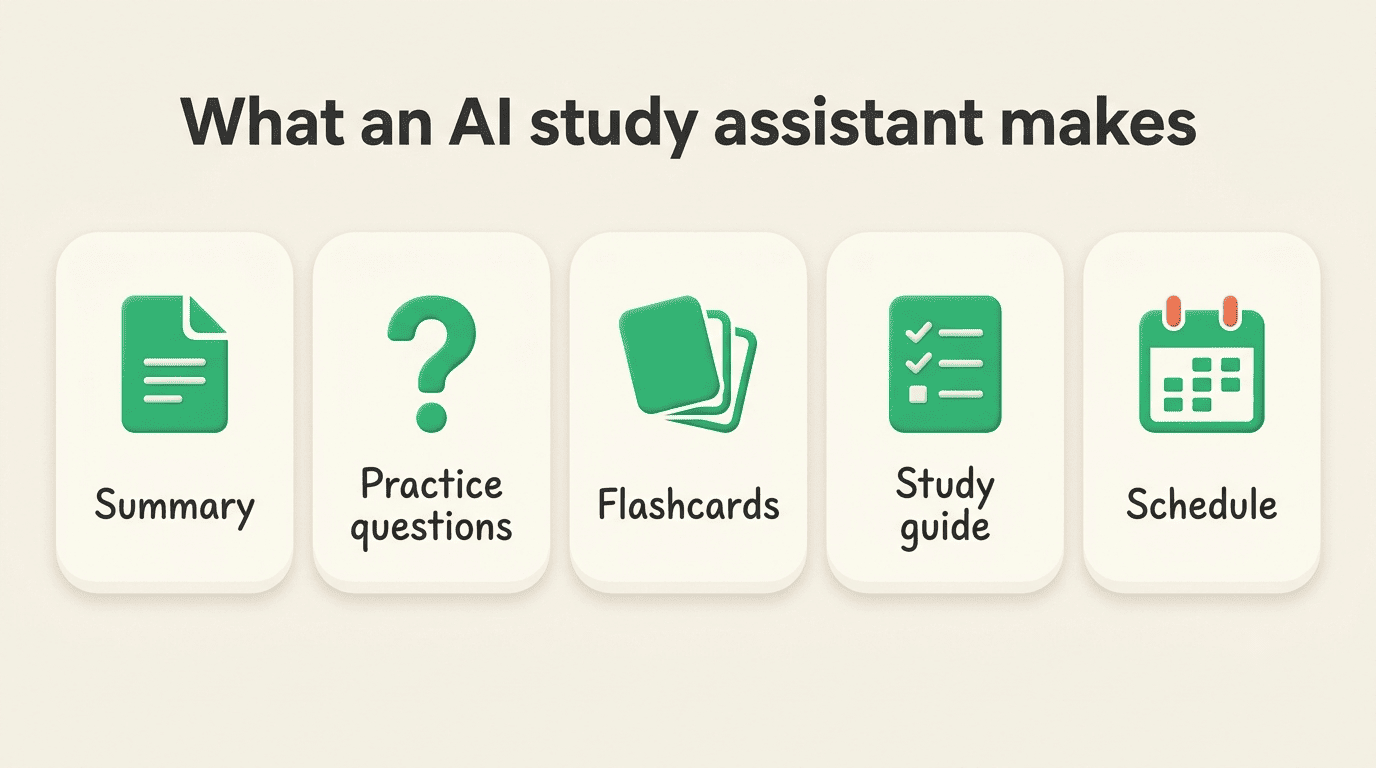
A capable AI study helper can produce most of a study kit from your own content:
- A concise summary of a chapter or lecture
- Exam-style practice questions by topic and difficulty
- Flashcards for terms, formulas, and definitions
- A study guide that highlights what to review
- A day-by-day study schedule up to your exam date
The point is speed on the boring part. Building a question bank by hand eats the time you should spend actually answering questions.
What it should not do
An AI study coach should not just hand you finished answers, because reading an answer is not the same as being able to produce it. The moment it solves the problem for you, the learning that would have happened during the struggle disappears. That is why the way you prompt it matters as much as the tool you pick.
Build a Study Plan with Spaced Practice
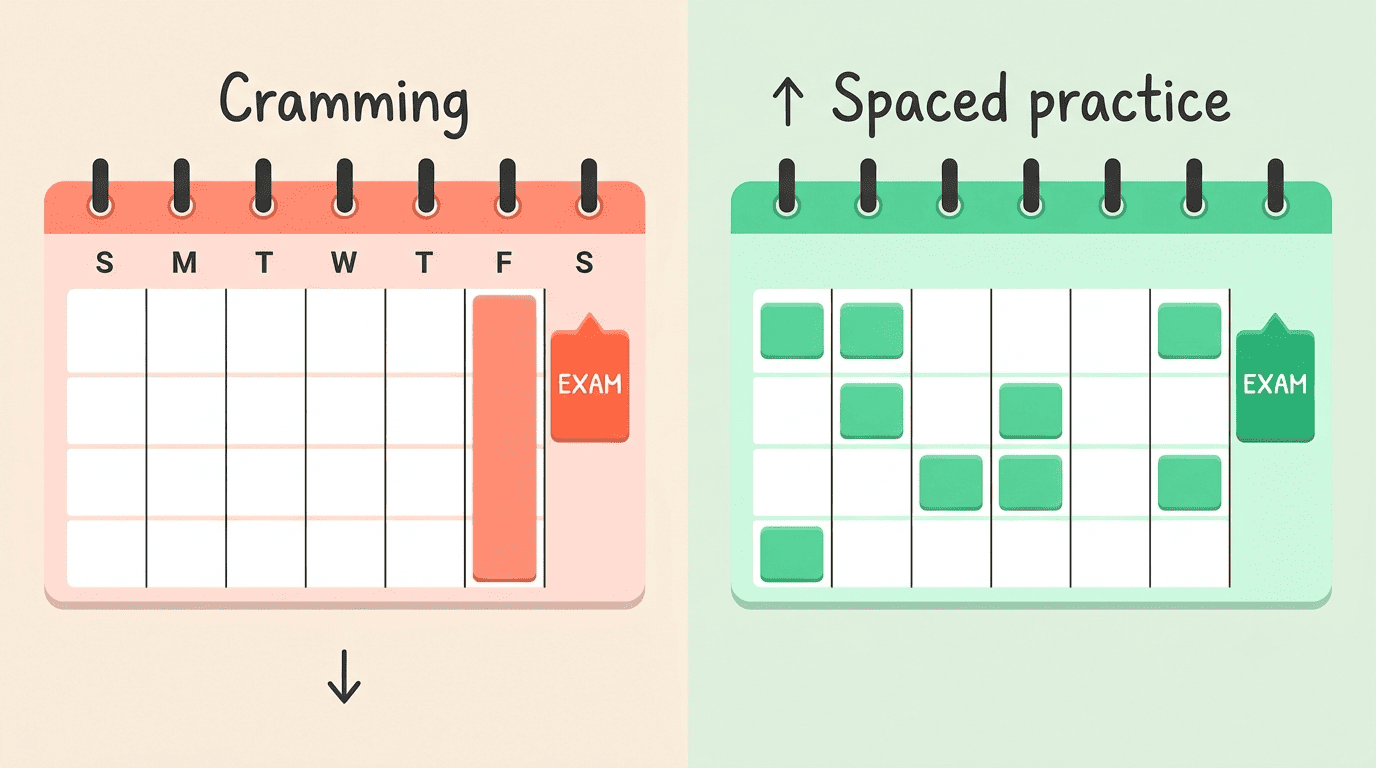
The single biggest scheduling mistake is leaving everything to the night before. Spreading study across several sessions, known as spaced or distributed practice, beats one long cram by a wide margin, and it is one of the most reliable findings in learning research.
Space it out, do not cram
Massed practice, cramming all your studying into one block, produces a steep drop-off in what you can recall later, while spacing the same hours across days holds the material far better. The University of Arizona’s guide to spaced practice recommends several short passes through the material across the week instead of one marathon. Ask your AI study assistant to build a schedule that allocates time to each topic and repeats weak areas.
Make it cumulative
A good exam plan is cumulative: you revisit all the material multiple times, not only the most recent week. An AI study coach is useful here because it can rotate older topics back into today’s session so nothing goes stale. Give it your exam date and topic list and ask for a spaced, cumulative plan.
Practice Testing: The Highest-Leverage Habit
If you only change one thing, change this: test yourself instead of rereading. Self-testing, a form of retrieval practice, is the habit most strongly tied to exam results. In one study, students’ own use of retrieval practice was a measurable predictor of later performance, documented in the research on retrieval practice and licensing-exam scores.
Test yourself the way the exam will
Have the AI generate practice questions from your notes or a past paper, then answer them from memory before you check anything. The closer your practice format is to the real exam, multiple choice, short answer, or full problems, the more the practice transfers. Cornell’s effective study strategies put self-testing at the center of good exam prep.
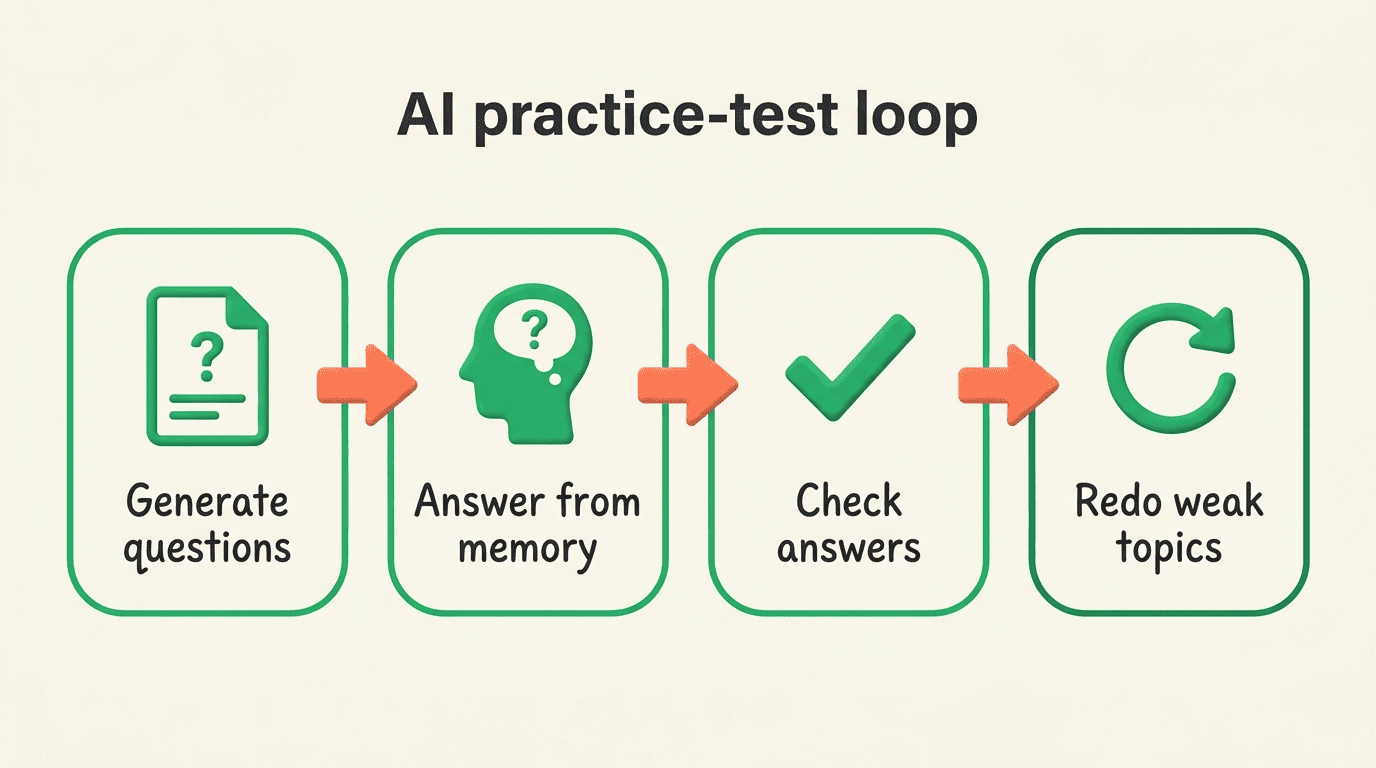
Here is a simple loop for running an AI-assisted practice test:
- Paste your notes or a past paper and ask for exam-style questions by topic.
- Close the notes and answer every question from memory.
- Only then reveal the AI’s explanations and correct answers.
- Mark what you missed and tag those topics as weak.
- Ask the AI to make fresh questions on just the weak topics.
- Repeat the weak-topic sets across several days, not in one sitting.
Timing your self-tests
Give the material a little time to settle before you test. Quizzing yourself on words still fresh on the page tests short-term echo, not memory, so put a gap between reading and self-testing to force genuine retrieval. Then space repeat tests over days so each one is a real challenge rather than a warm recap.
Use an AI Study Coach the Right Way
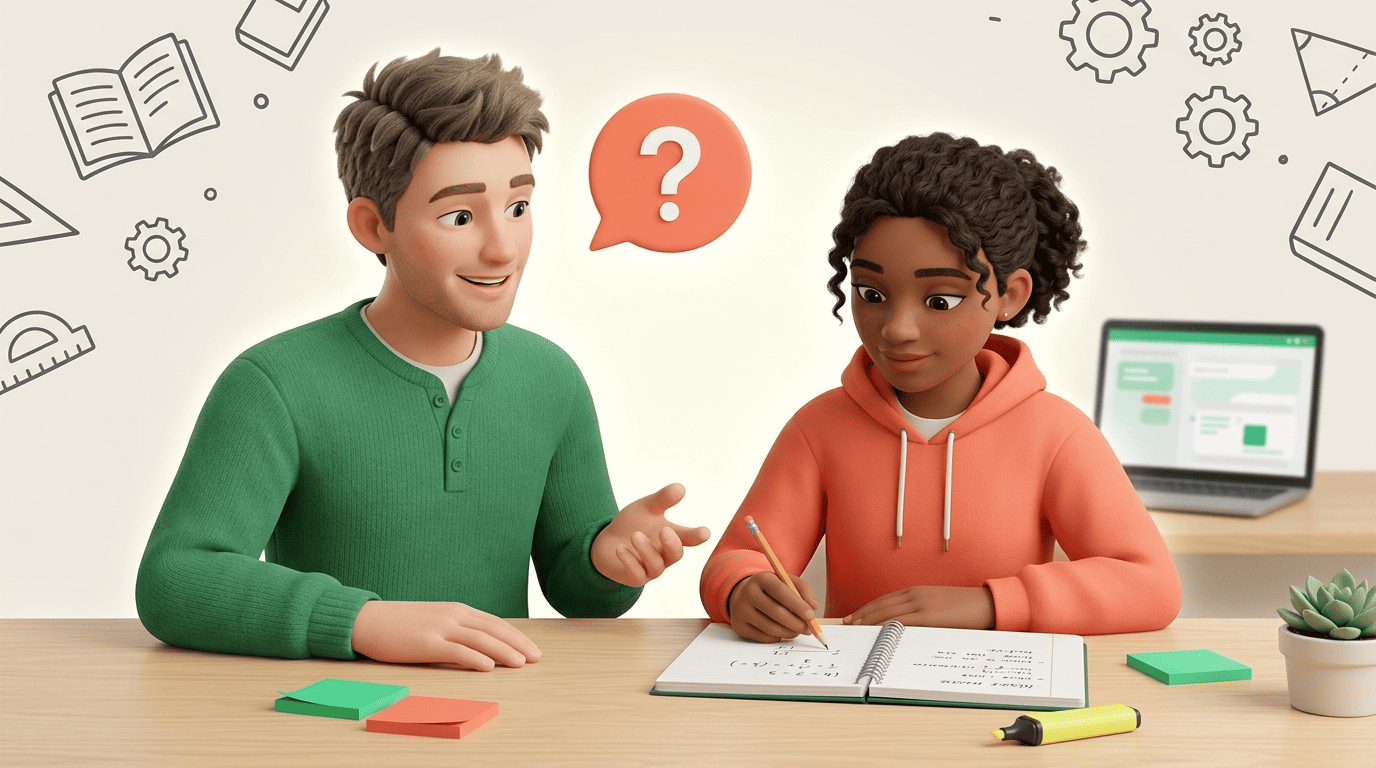
The difference between an AI study coach that helps and one that quietly does your thinking comes down to the persona you give it. Tell it to act like a tutor who questions you, not an answer key.
Make it a tutor, not an answer key
Duke University’s Academic Resource Center suggests a prompt that keeps you in the driver’s seat.
If I am unable to solve a problem, do not give me the answer. Ask me leading questions to help me produce the answers myself.
Duke University Academic Resource Center
That single instruction turns the AI study assistant into something closer to a patient tutor: it nudges you toward the answer so the recall stays yours. Keep the tutor persona in your prompt whenever you work through hard problems.
Verify what it gives you
An AI can be confidently wrong, inventing a plausible date, formula, or definition. Treat generated material as a draft and check anything testable against your textbook or slides, especially numbers and technical details, before you memorize it.
Time, Focus, and Exam-Day Readiness
Good material and a good plan still need focus to execute. A few time-management habits carry most of the benefit, and none of them require an app.
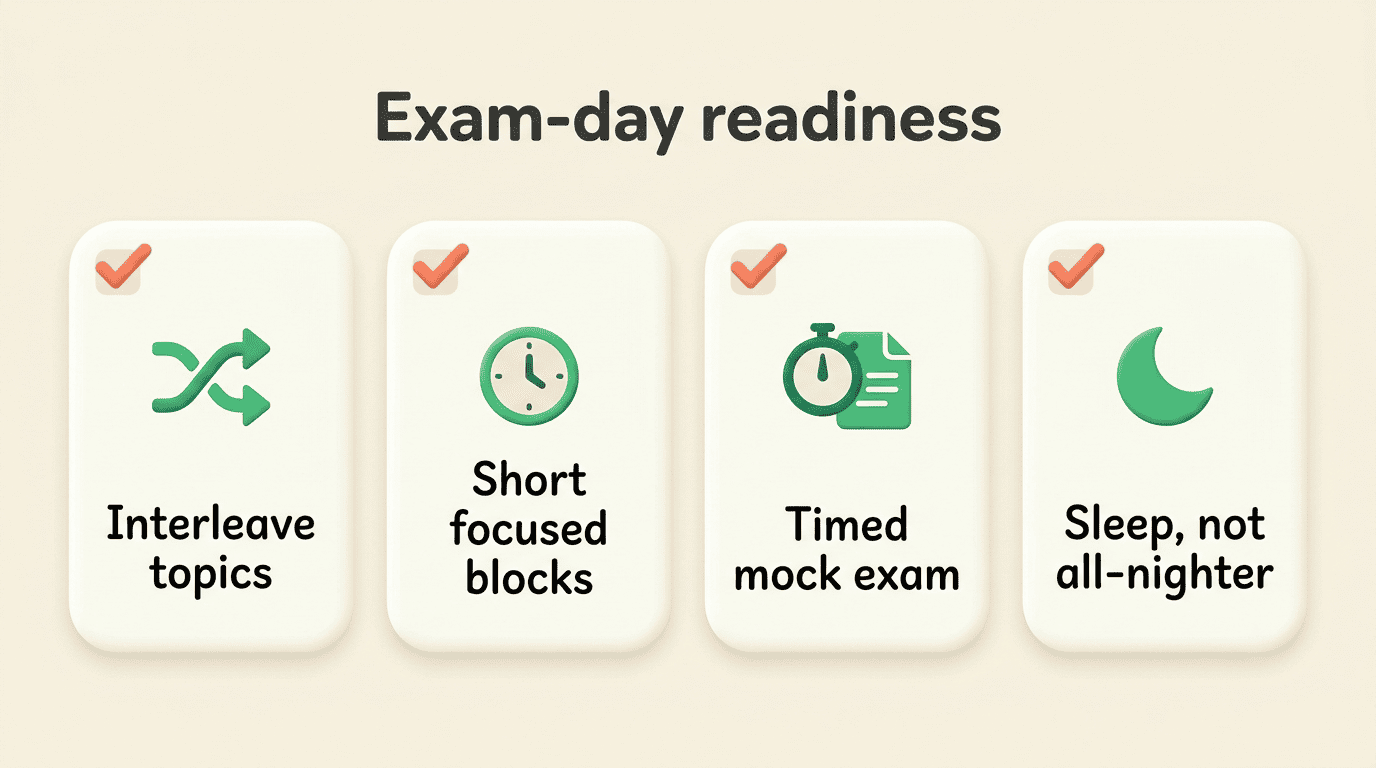
Interleave related topics. Instead of drilling one topic until it is perfect, rotate between related topics in a session. Mixing them forces your brain to choose the right method each time, which is closer to what an exam demands.
Work in short focused blocks. Study in timed stretches with short breaks rather than open-ended marathons; attention fades fast, and a quick reset keeps quality high.
Do a timed mock exam. A full practice test under exam-like conditions is the best cure for test anxiety, because most nerves come from facing an unfamiliar format. Do it a few days out, not the night before.
The table below sums up the habits and how an AI study helper supports each one.
| Habit | Why it works | How AI helps |
|---|---|---|
| Spaced practice | Beats cramming for retention | Builds a day-by-day schedule |
| Practice testing | Predicts exam performance | Generates questions from your notes |
| Tutor-style prompting | Keeps recall yours | Asks leading questions, not answers |
| Timed mock exam | Reduces test anxiety | Assembles a full practice paper |
Academic Honesty: Prep With AI, Take the Exam Yourself
Using AI to prepare for an exam is a legitimate study aid, the same as a tutor quizzing you or a study group trading questions. It plans, quizzes, and explains; it does not sit the exam for you, and it is not a shortcut around understanding the material.
The line is clear. An AI study assistant that helps you build a plan and practice tests supports honest studying. Pasting real exam questions in to get answers you never learned, or bringing the tool into a closed exam, crosses into cheating and breaks most schools’ rules. Learn the material honestly during prep, and the confidence you carry into the room on exam day is the payoff.