AI Study Buddy: What a 24/7 Learning Companion Can (and Can’t) Do
An AI study buddy is a 24/7 learning companion that explains topics, quizzes you, and summarizes readings the moment you get stuck — no appointment, no waiting. A good AI study buddy is a real study aid, but only when you treat it the right way: verify what it tells you and keep the actual learning yours.
That is the whole trust question in one line. An AI study companion is always available and endlessly patient, yet it can also be confidently wrong — so how much you can rely on it depends less on the tool and more on how you use it.

What an AI study buddy is
Strip away the branding and an AI study assistant is a companion, not a vending machine. You bring a topic you are struggling with, and it helps you understand it — explaining, quizzing, and summarizing — rather than simply spitting out a finished answer to copy.
A companion, not an answer machine
The useful mental model is a tireless tutor. Like an intelligent tutoring system, it adapts explanations to how you learn and responds to your specific confusion. The difference between a study buddy and a homework-answer bot is intent: one helps you get it, the other just hands you the result.
Always available, infinitely patient
The headline feature is availability. An AI learning companion does not close at 5 p.m., does not sigh when you ask the same question a fourth time, and does not judge you for not understanding. For anxious students who hesitate to raise a hand in class, that non-judgmental patience is not a gimmick — it is often the reason they finally ask.
That patience comes with real trade-offs against a human tutor, and it helps to see both sides at once.
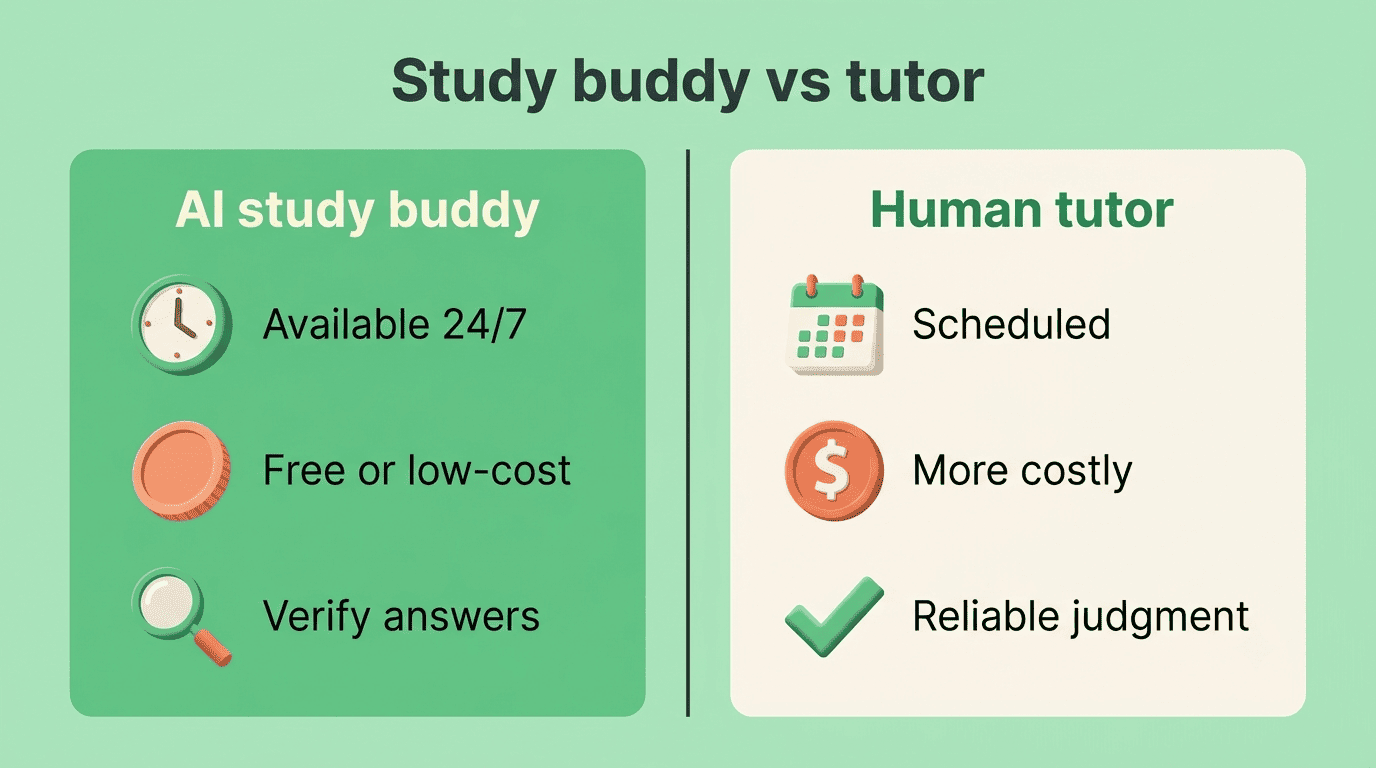
| AI study buddy | Human tutor | |
|---|---|---|
| Availability | 24/7, instant | Scheduled sessions |
| Cost | Free or low-cost | Often expensive |
| Patience | Endless, non-judgmental | Limited by time |
| Accuracy | Can hallucinate — verify | Accountable, reliable |
| Judgment | None; no real understanding | Reads you, adjusts, mentors |
Why 24/7 actually matters
Availability sounds like a marketing line until you remember when studying actually happens: late at night, the weekend before an exam, the hour a concept finally clicks or completely fails to.
Help at the moment you’re stuck
A human tutor you see on Tuesday cannot rescue you at 11 p.m. on Sunday. A 24/7 AI tutor catches the exact moment of confusion, which is when help does the most good — before frustration turns into giving up.
A real-world example: FoondaMate
Scale shows why this matters. According to Meta’s AI team, the study buddy FoondaMate — which runs inside WhatsApp and Messenger and is built on Meta’s Llama models — is used by more than 3 million students who have asked it over 100 million questions. Its founders, Dacod Magagula and Tao Boyle, aimed it at students in large, under-resourced classrooms where one-on-one help is scarce.
The impact of a 24/7 study buddy, accessible on an application students already use, is utterly transformative in environments like this.
Tao Boyle, co-founder of FoondaMate
What an AI study buddy does
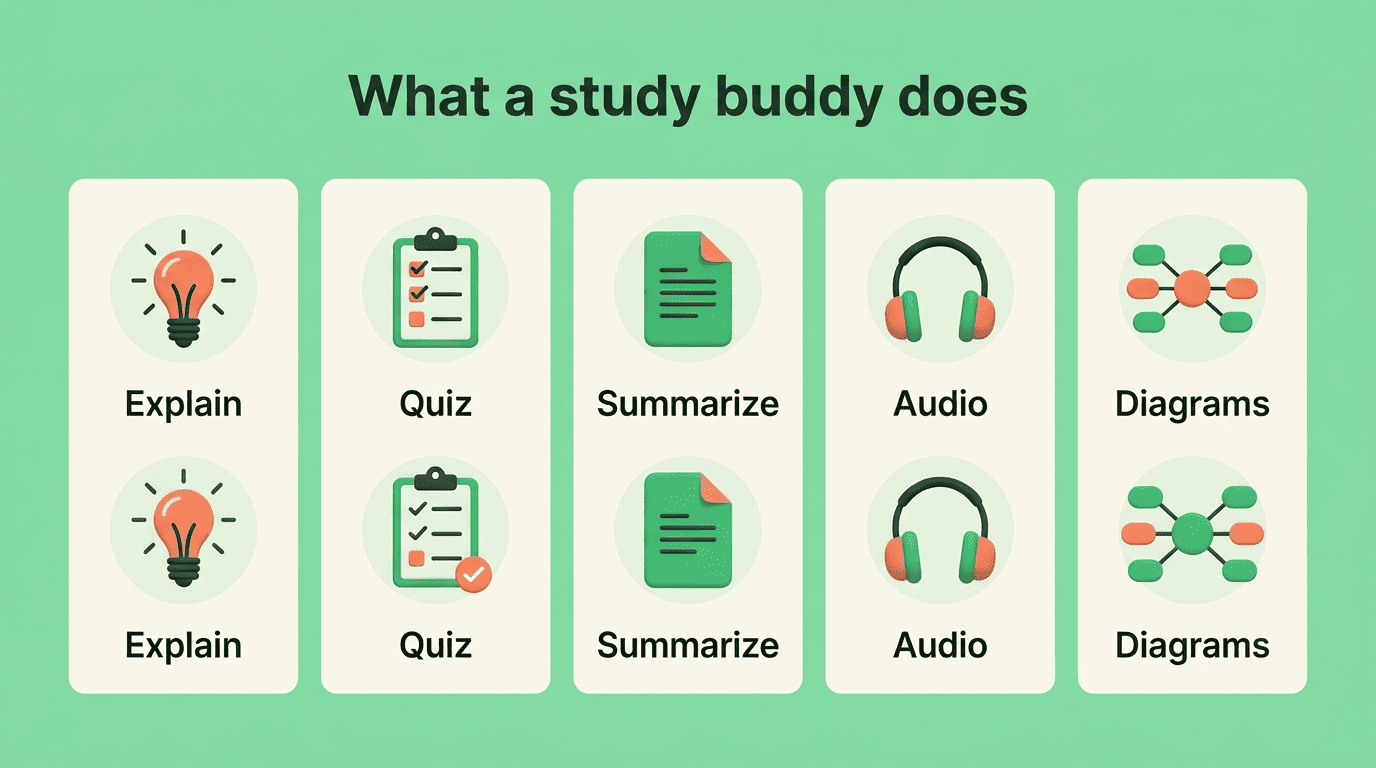
Beyond being available, a study companion earns its keep through a handful of concrete tasks. The table maps the most common ones.
| You need to… | How the study buddy helps |
|---|---|
| Understand a hard concept | Explains it with examples tuned to how you learn |
| Practice before a test | Generates quizzes and flashcards from your notes |
| Get through a long reading | Summarizes chapters into outlines and key points |
| Study on the go | Produces audio summaries and simple diagrams |
| Check a diagram or chart | Analyzes an image you share and explains it |
Explain, quiz, summarize
The core loop is understand, then practice. A study buddy breaks a concept down with tailored examples, then turns your own notes into practice quizzes and flashcards so you can test yourself. Microsoft’s education team describes the same trio — explaining, creating study materials, and generating practice questions — as the everyday work of an AI study companion.
Study your way
Good companions flex to your style. Ask for an audio summary if you learn by listening, a mind map if you think visually, or a step-by-step walkthrough if you need structure. Share a photo of an anatomy chart or a physics diagram and it can read the image and explain what you are looking at.
Can you trust an AI study buddy?
Here is where the trust question gets real. An AI study buddy is powerful, but it is not an oracle, and using one well means knowing exactly where it fails.
It can be confidently wrong
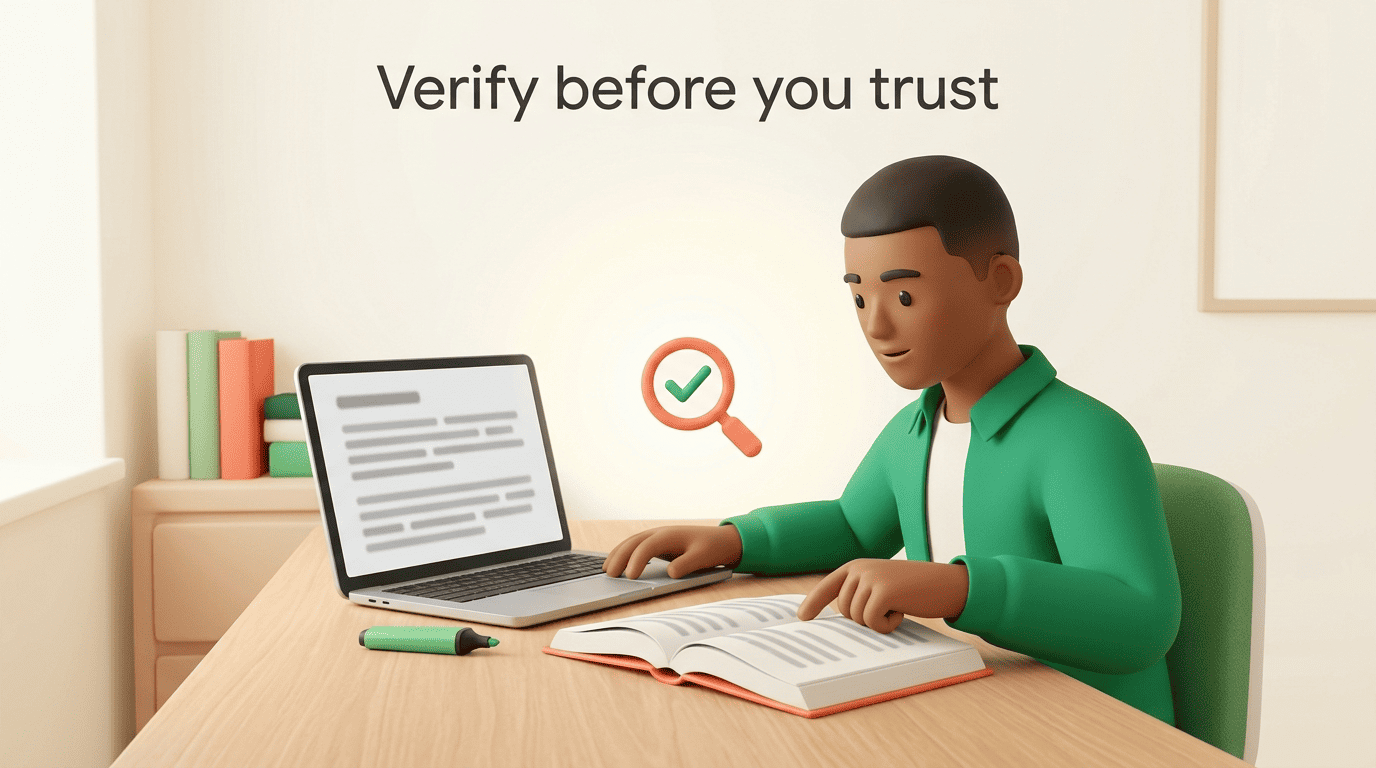
The single most important thing to understand is that AI can hallucinate — produce fluent, plausible-sounding answers that are simply false. This is not rare and it is not obvious, because a wrong answer looks exactly as confident as a right one. Treat every fact, date, formula, and citation as something to check against your textbook or an authoritative source.
Guard your privacy
An AI study assistant is still an app that receives whatever you type. Do not paste sensitive personal information, and take a moment to understand what a tool stores and how it uses your data. Favor companions with clear, readable privacy policies over ones that are vague about it.
Use it as a supplement, not a substitute
The safest frame comes straight from Microsoft’s guidance for students, and it is worth taking literally.
It’s important to verify information and use AI as a supplement—not a substitute—for learning.
Microsoft Copilot for students
A study buddy is a coach standing next to you, not the author of your work. It can point, explain, and drill you — but the understanding has to end up in your head, not just on your screen.
Help, not cheating — the integrity line
Trusting a tool also means using it honestly, and the line here is clearer than most students assume.
Where the line is
Using an AI study companion to explain a concept, quiz yourself, or summarize a reading is legitimate studying. Submitting AI-written work as your own — an essay, a problem set, a lab report — is cheating. Microsoft puts it plainly: academic integrity matters, and you should avoid using AI in ways that violate your school’s policies. Those policies differ by campus and even by instructor, so check yours before you rely on any tool.
Habits that keep it honest
A few habits keep you clearly on the right side:
- Verify anything factual against your textbook or a trusted source.
- Write final answers and essays yourself, in your own words.
- Cite or disclose AI help when your syllabus asks you to.
- When in doubt, ask your instructor what is allowed.
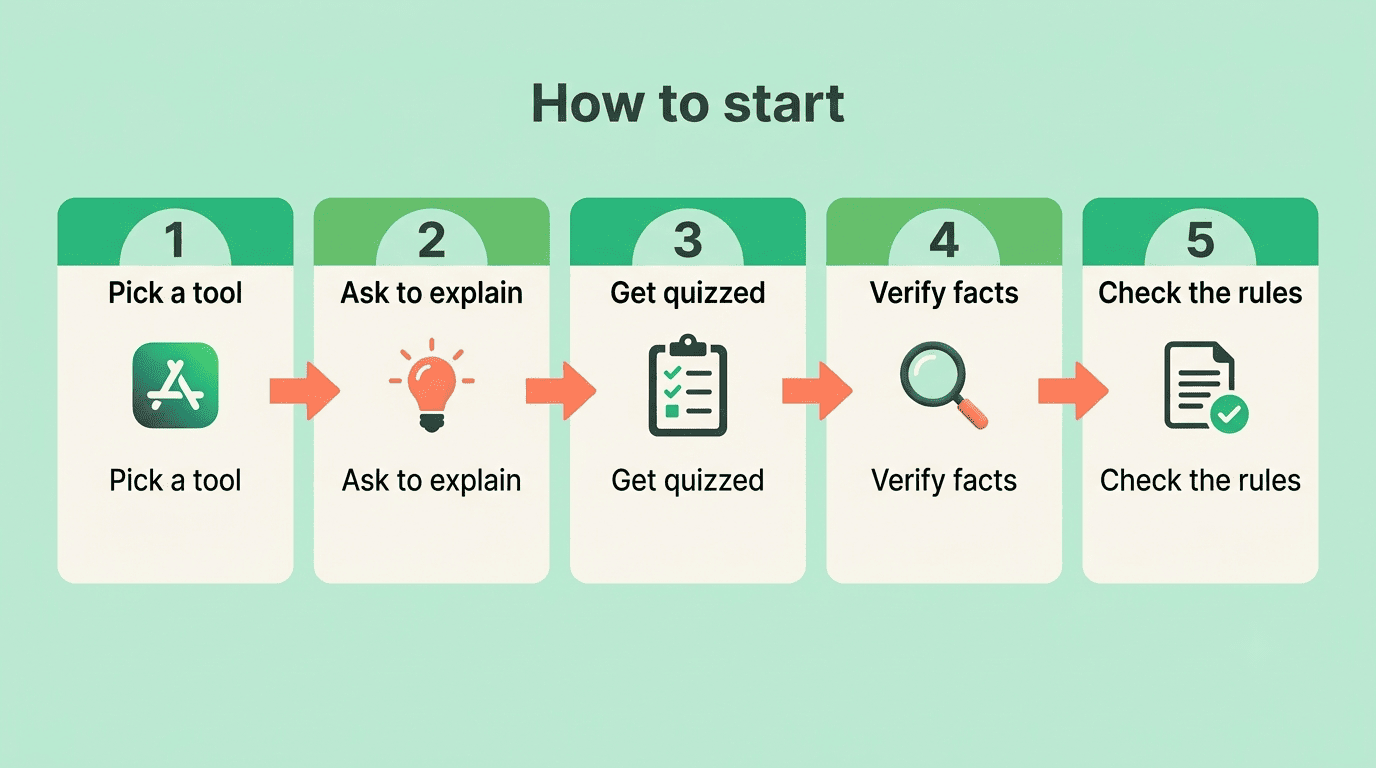
How to start with an AI study buddy
You can put a study companion to work in about ten minutes:
- Pick a tool with a real free tier so you can try it without a card.
- Ask it to explain one topic you are currently stuck on.
- Have it quiz you on that topic and check where you slip.
- Verify anything factual it told you against your course materials.
- Ask it to keep a running summary you can review later.
- Check your syllabus for any rules on using AI before an assignment.
Keep it aimed at understanding, verify as you go, and an AI study buddy becomes exactly what the name promises — a companion that helps you learn, not one that learns for you.